
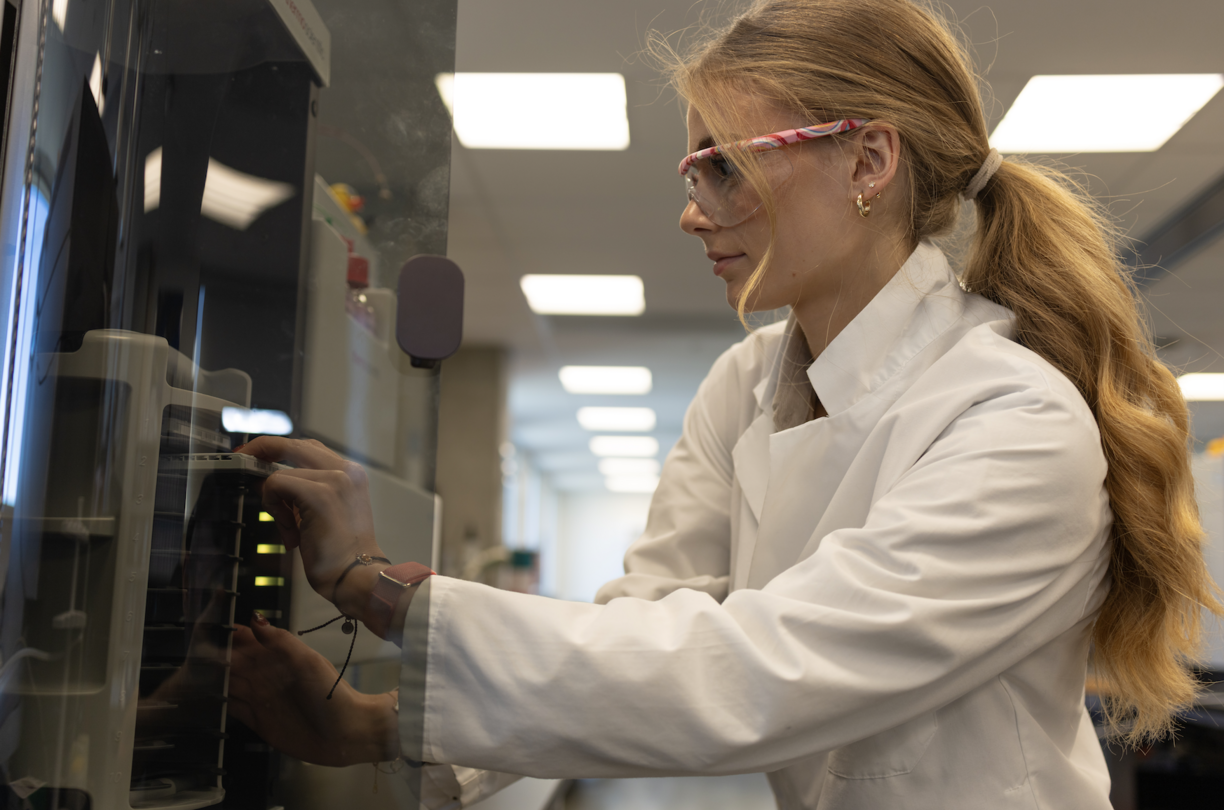
Ava Henwood has been working with Dr. Chris Gill’s research team in the Centre for Health and Environmental Mass Spectrometry lab for the past two summers.
How next-generation technology that saves lives is being developed by researchers at VIU.
By Ursula Leonowicz, National Post. Reprinted with permission.
From blue-green algae, some of which produce potentially deadly toxins, to drug testing methods that can help limit the harm of the ongoing opioid crisis, Chris Gill’s research at Vancouver Island University spans the gamut. The connecting thread? Direct mass spectrometry.
Direct mass spectrometry is an analysis technique that doesn’t require the operator to separate different chemical compounds before being “read” by a mass spectrometer. It saves time and allows for real-time tracking, which can be critical in many applications from drug checking to environmental issues.
“We circumvent a lot of the extra steps and time-consuming process of conventional chemical measurements. Existing methods are good but have bottlenecks in terms of being able to get results quickly,” explains the analytical mass spectrometrist.
Gill is co-director of VIU’s Centre for Health and Environmental Mass Spectrometry. He recently received ongoing and increased funding from the Natural Sciences and Engineering Research Council of Canada to help support his research.
“Direct mass spectrometry is becoming more common, but we’re still pioneering very quick and effective measurement techniques to adjust medications that are critical, or in the case of emergency room situations, being able to know what caused an overdose.”
Gill’s goal is to develop new mass spectrometry technology and tools that could be used to measure environmental, forensic and clinical samples for harm reduction, drug testing, responding to environmental issues and assisting first responders in the field. Measurements could then be done in mere seconds, instead of having to send samples to a lab and wait for results.
“’Better, faster, cheaper’ is the lab motto,” says Jindar Sboto, who spent the last few years working with Gill as an undergraduate in VIU’s Chemistry department. Sboto is continuing his research with Gill at VIU as a University of Victoria PhD student.
“My research focuses on developing direct mass spectrometry techniques to measure harmful substances in drugs and help diagnose health issues such as kidney disease,” he said.
Providing a full continuum of student training is essential to Gill’s research, no matter what area it’s in. This provides consistency as well as transfer of knowledge, while also ensuring VIU students can contribute to life-saving and life-changing spectrometry technologies.
“Using paper spray mass spectrometry, which is a novel ionization technique, I’m looking at six different vitamin D metabolites, two of which are used clinically to diagnose deficiency,” says Ava Henwood. She is a fourth-year Chemistry major who has been working with Gill’s team for the past two summers and is developing vitamin D measurements as part of her undergraduate thesis.
Gill was awarded the first Provost’s Distinguished Researcher Award to recognize his many impactful contributions involving student-centred research and training in 2018, proving that small universities can produce big ideas. Indeed, they are often more likely to, thanks to the close community students and educators form at smaller universities.
This article originally appeared in The National Post and is reprinted with permission.
Related Posts


